


Offer
Provide additional details about the offer you're running.
FLASHSALE
This store requires javascript to be enabled for some features to work correctly.


Last Updated: October 16, 2026
Choosing between synthetic and human hair comes down to one question: how much time, money and styling freedom do you actually want? Human hair wigs look and behave like your own hair and can be heat-styled and recoloured, but they cost more and need real care. Synthetic wigs hold a set style, resist humidity and cost far less, but they cannot take high heat.

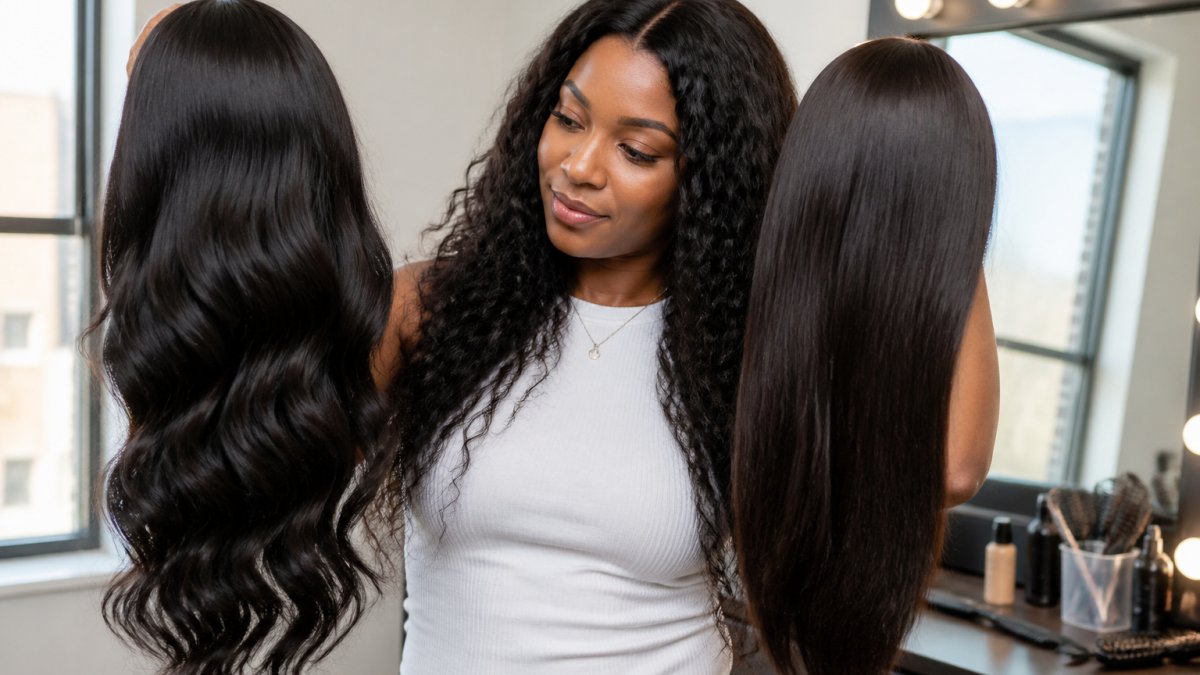
Human hair wigs are made from donated or collected hair that has been cleaned, treated and hand-tied or machine-wefted onto a cap.
Synthetic wigs are made from fine polymer filaments extruded into strands, then set into a permanent wave or curl pattern using heat during manufacturing.
The practical difference: human hair is a blank canvas, synthetic hair is a finished product. One you style, the other you wear as-is.
Human hair vs synthetic hair extensions is really a question about your calendar. Human hair suits wearers who style daily, want colour changes, or need the most undetectable finish. Synthetic suits wearers who want a reliable look with almost no effort.
How long do synthetic wigs last? With careful wear, most synthetic wigs hold their style for around four to six months of regular use before the fibre dulls or tangles at the ends. According to industry benchmarks, this lifespan can be extended with proper care and by rotating between multiple pieces.

The catch is that "lasts longer" only holds if you maintain it. Human hair needs washing, conditioning, detangling and careful storage. Synthetic needs far less, but once the fibre frays there is no bringing it back.
| Fibre | Typical lifespan | Heat styling | Maintenance load |
|---|---|---|---|
| Synthetic | Four to six months | No high heat | Low |
| Human hair blend | Six to nine months | Limited low heat | Medium |
| Human hair | A year or more | Full heat styling | High |
Heat resistance is the clearest dividing line between the two fibres, but the word "synthetic" hides a critical distinction that most buying guides skip: standard synthetic and heat-friendly synthetic are not the same product, and treating them as one is how people ruin wigs.

Standard synthetic fibre, sometimes labelled kanekalon, toyokalon or simply "synthetic", is extruded polymer set into a permanent curl or wave during manufacturing. That set is what makes the style spring back after washing.
Heat-friendly synthetic (often sold as "heat-resistant", "heat-defiant" or "HD fibre") is a modified polymer blend engineered to tolerate low-to-mid heat without losing its set. It behaves more like human hair under a tool, but only within a narrow band.
Synthetic fibre does not recover from heat damage the way human hair does. Human hair can be deep-conditioned, re-moisturised and partially repaired after a bad heat pass because it is a protein structure.
A practical rule most practitioners follow: even on heat-friendly fibre, stay at least 20°C below the stated maximum, use the lowest effective tool setting, and never hold the tool on one section for more than a couple of seconds.
Colour follows the same logic as heat. Human hair can be tinted, toned or lightened by a professional, though repeated chemical processing, especially lightening, shortens its life and can compromise the cuticle.
That said, synthetic arrives pre-styled and pre-coloured. A layered cut, a fringe, a balayage effect, a defined wave: all of it is baked in and survives washing. If you never plan to change your look, that is a feature, not a limitation.
Scalp comfort comes down to cap construction and weight, not fibre type. A hand-tied or lace-front cap sits flatter and breathes better than a bulky machine-wefted one, and a lightweight build matters more in warm weather than any fibre choice.
Care routines differ sharply:
Questions to ask a hair extension supplier separate a good purchase from an expensive mistake. Ask these before you pay:
Big Star Short Black Pixie Wig — Synthetic & Human Hair Blend, Side Swept Fringe →
That last question matters more than most buyers realise. Transparency about sourcing and processing is the clearest signal of a supplier who stands behind their product.
Upfront price is the number buyers fixate on and the number that most often leads to the wrong decision. The real comparison is total cost of ownership: purchase price plus care products, plus any salon services, plus replacement frequency, divided by the number of wears you actually get. Run that maths and the ranking of "cheap" and "expensive" often flips.
At Big Star Hair & Beauty, our human hair blend wigs start at $250, with a long layered blonde blend at $280 and a 32-inch 100% human hair lace front wig at $1,500.
Take a $280 human hair blend worn three times a week. If it lasts nine months, that is roughly 117 wears, or about $2.40 per wear before care products.
Now take a $120 synthetic piece worn the same three times a week. If it lasts five months, that is roughly 65 wears, or about $1.85 per wear before care.
| Option | Upfront cost | Replaced every | Best for |
|---|---|---|---|
| Synthetic | Lower | Four to six months | Occasional wear, events |
| Human hair blend | Mid-range | Six to nine months | Regular wear, natural look |
| 100% human hair | Higher | A year or more | Daily wear, heat styling |
The synthetic advantage shrinks or disappears when:
The human hair advantage shrinks or disappears when:
A common mistake is buying on upfront price alone. Work out cost per wear: divide the total cost, purchase plus care plus any salon spend, by the number of wears you expect. A piece you wear three times a week for a year beats a bargain you replace every season. Keep a simple note of when you bought each piece and when you retired it; after two or three cycles you will know your real wear rate, and the next decision becomes arithmetic rather than guesswork.
With daily wear, a synthetic wig typically lasts around four to six months before the fibres lose their shape and start to frizz. Rotating two wigs and storing them on a stand between wears can stretch that further. Human hair wigs generally last longer with proper care, often a year or more, but they need more washing and styling time. If you plan to wear a wig every day, factor replacement cost into your budget rather than treating it as a one-off purchase.
Most standard synthetic fibres cannot take heat from curling wands or straighteners because they melt rather than reshape. Some newer heat-resistant synthetic fibres can handle low heat, but you must check the label before trying. Human hair wigs and human hair blends, like the Big Star 32-inch Straight Brown & Honey Blonde Highlight Human Hair Lace Front Wig, can be curled, waved or straightened with heat tools. If styling flexibility matters to you, that difference alone often decides the choice.
Human hair wigs generally look the most natural because the cuticle moves, catches light and falls the way your own hair does. A lace front construction adds to this by creating an undetectable hairline. That said, a good quality human hair blend can look very close to real hair at a lower price. Shine is the giveaway: pure synthetic wigs often reflect light in a flat, uniform way, while human hair and blends have a softer, more varied sheen.
Synthetic hair is easier day to day because it holds its style and needs less washing, but it has limits. You cannot use heat tools on most synthetic fibres, and tangling gets worse as the wig ages. Human hair behaves like your own hair, so you wash, condition and style it the same way, which takes more time but gives you more control. For a low-maintenance routine, a human hair blend sits in the middle: softer than pure synthetic, less demanding than full human hair.
Synthetic wigs suit beginners who want a ready-to-wear option at a lower price point. They hold their shape, need no styling and are simple to store. Human hair wigs suit beginners who plan to wear the piece often and want to change the style. A human hair blend is a practical middle ground: it looks natural, keeps its shape between wears and costs less than a full human hair wig. Start with your wear frequency, then match the fibre to it.
It depends on how often you wear the piece and whether you want to style it. A full human hair wig costs significantly more upfront, but it lasts longer and can be heat-styled, coloured and treated like your own hair. If you wear a wig daily and change your look often, the cost per wear can work out lower than replacing a synthetic wig every few months. For occasional wear, a synthetic or blended option usually gives better value.
Ask what the fibre actually is, whether it is pure synthetic, a blend or full human hair, and whether it can take heat. Confirm the cap construction and whether it suits your scalp and hair type. Ask about the return policy if the product does not match the description. Also ask about care instructions and expected lifespan for daily wear. A supplier who answers these clearly is worth buying from; vague answers are a warning sign.
A burn test is the traditional method: human hair burns to ash and smells like burnt hair, while synthetic fibre melts into a hard bead and smells like plastic. In practice, you rarely get to test before buying. Look at the shine instead. Synthetic fibre reflects light in a flat, uniform way, while human hair has a softer, less consistent sheen. You can also check how the hair moves; human hair falls and swings more naturally than most synthetic fibres.
"Show off incredible feedback from your customers"