


Offer
Provide additional details about the offer you're running.
FLASHSALE
This store requires javascript to be enabled for some features to work correctly.


Last Updated: October 12, 2026
Thin damaged hair changes the rules for hair extensions. Chemically lightened, heat-styled or over-processed strands hold less weight, break more easily, and show every attachment point, so methods that work on dense, healthy hair can cause real harm. At Big Star Hair & Beauty, the best hair extensions for thin damaged hair are the lightest, most removable options: clip-ins, halo-style pieces and toppers, with tape-ins only when a professional confirms your hair can carry them.
Most extension guides assume healthy hair, ranking methods by longevity or fullness rather than tension on the strand.
Damaged hair has a weakened cuticle, so it grips adhesive unevenly and snaps under loads healthy hair shrugs off. A tight-line or bonded installation concentrates weight at the scalp, exactly where compromised hair is most vulnerable.
Answer three questions honestly before choosing anything.
If you answer "very thin," "yes, breaking," or "minimal time," lean toward a removable piece.
| Method | Damage Risk | Wear Time | Best For | Removable at Home |
|---|---|---|---|---|
| Clip-in | Low | Daily | Thin hair wanting occasional fullness | Yes |
| Halo | Very low | Daily | Fragile hair, no attachment tension | Yes |
| Tape-in | Moderate | 4-8 weeks | Fine hair with stable density | No |
| Weft (hand-tied) | Moderate to high | 6-8 weeks | Thicker hair adding length | No |
| Bonded/keratin | High | 3-4 months | Healthy hair only | No |
For thin damaged hair, the top two rows are where you should start. Let's look at each in turn.
Tape-in extensions for fine hair work best when panels are light and placement avoids the most fragile zones.
The catch is weight distribution. Tape-ins attach in rows, so if your hair is thin at the crown, the top row pulls on the weakest section. We place tape-ins lower, below the part line, and keep the piece count conservative.
Our BigStar Virgin Remy Tape In Human Hair Extensions use cuticle-intact Remy hair from a single donor, which keeps the strands aligned and reduces tangling. For a lighter option, the Human Hair Tape Extensions use a natural skin weft for a flatter profile.
Clip-in extensions for thin hair are the safest entry point: they attach and release daily, so there's no adhesive and no sustained tension.
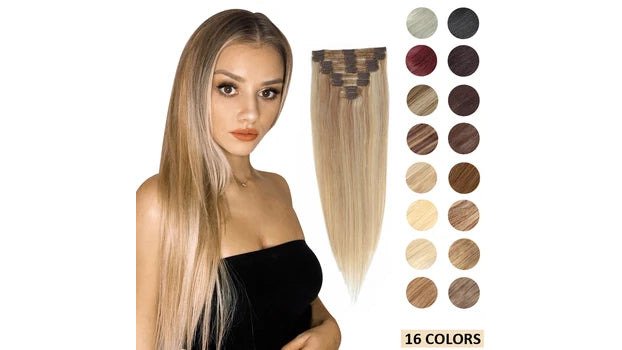
Our 100% Remi Human Hair Clip-In Extensions add instant volume with a lightweight feel, and the Water Wave Clip-In set gives a full 8-piece, 120g option for a beachy finish.

For thin hair, start with fewer pieces. Two or three wefts placed at the back add fullness without overloading the front.
Hiding extensions in thin hair comes down to placement and blending. Keep attachment points away from the part line and thin areas, then soften the transition with your natural hair.
A few practical rules:
If your thinning is concentrated at the top, a clip-in topper covers the crown and part line far more discreetly than any strand extension. Our Toppers clip into your natural hair, blending seamlessly to enhance thickness or conceal thinning areas. The Highlight Blonde Crown Topper is also available.


Hair extension care for damaged hair means treating your natural strands as the priority. Compromised hair has a lifted or worn cuticle, so it absorbs water faster, dries more brittle and grips adhesive unevenly. Every wash, brush and removal either protects the hair underneath or strips more of it away.
Healthy hair tolerates friction and tension because the cuticle scales lie flat and the cortex holds moisture. Damaged hair has gaps in that outer layer, so it loses moisture quickly and snaps under loads healthy strands shrug off. That changes three things:
Bigstar 14 inch Short Curly Silk Base Hair Topper Virgin Human Hair Toupee →
The single most protective habit is removing clip-ins and halos before bed. Overnight friction is where most extension-related breakage happens.
Removal is where a lot of damage occurs, and it is the step most guides skip. Tape-in adhesive softens with a professional remover and should slide out with the panel, not peel away from the strand; bonded and keratin methods need a similar breakdown step. Pulling any of these out dry tears the cuticle and can pull hair from the follicle.
Stop and reassess if you notice any of the following:
Persistent tension causes traction damage, and it is easier to adjust a row early than to grow out a bald patch.
| Method | Daily care | Professional maintenance | Removal |
|---|---|---|---|
| Clip-in | Remove nightly, brush before and after wear | None | At home |
| Halo | Remove nightly, store on a stand | None | At home |
| Tape-in | Avoid conditioner at the bonds, dry roots gently | Re-tape every 4-8 weeks | In salon |
| Weft (hand-tied) | Loosen rows, avoid heavy pulling styles | Tighten every 6-8 weeks | In salon |
| Bonded/keratin | Keep bonds dry, avoid oil at the root | Maintenance every 3-4 months | In salon |
If your hair is actively breaking, the safest routine has the fewest attachment points and shortest wear time. A halo or clip-in set that comes out nightly gives fragile hair a recovery window no long-wear method can match.
Realistic costs depend on method and piece count, so plan the ongoing spend, not just the purchase. Re-taping, tightening, replacement hair and professional removal all add up, and long-wear methods carry the highest ongoing cost because they need salon time every few weeks.
| Method | Upfront | Ongoing | Removal |
|---|---|---|---|
| Clip-in | From $90.54 | Replacement when worn | At home |
| Halo | Varies by piece | Replacement when worn | At home |
| Topper | From $229.13 | Replacement when worn | At home |
| Tape-in | From $180 | Re-tape every 4-8 weeks | In salon |
| Weft (hand-tied) | Quote on consultation | Tighten every 6-8 weeks | In salon |
| Bonded/keratin | Quote on consultation | Maintenance every 3-4 months | In salon |
A removable setup is often the most affordable way to add fullness while your hair recovers, with no recurring salon cost or adhesive to maintain. Long-wear methods can cost more over a year than the initial install suggests once re-taping, tightening and removal are counted.
Extensions sit on top of a problem; they do not fix it. Hold off if any of these apply:
If you are unsure whether your hair is ready, book a consultation rather than an installation. A professional can assess density, breakage and scalp health in person, and it is far cheaper to be told to wait than to treat traction damage later.
Our in-salon service includes seamless wig and extension installations.
Clip-in extensions are usually the safest starting point for thin damaged hair because they attach and remove daily with no adhesive, heat or tension on the scalp. If you want something more permanent, tape-in extensions using lightweight wefts can work when your stylist spaces them to avoid overloading fragile areas. Toppers are another option for thinning crowns, as they clip in and add coverage without pulling on the hair around your parting.
Yes, if the weight, attachment method or aftercare is wrong. Bonded and tightly braided methods concentrate tension at the root, and damaged hair breaks more easily under that load. Signs to watch for include sore spots at attachment points, increased shedding when you brush, and visible thinning around bonds. Choosing low-tension methods, keeping the extension weight light, and booking regular removal and reinstallation helps reduce the risk.
Tape-in extensions for fine hair work well when the panels are thin and lightweight, because the flat bond sits close to the scalp and stays discreet. The key is weight distribution: your stylist should place fewer, narrower panels rather than thick wefts, and leave enough natural hair between rows to support each bond. Virgin Remy tape-in sets with cuticle-intact hair, such as BigStar's 40-piece tape-in extensions at $250, are a practical option because the hair stays smooth and the panels remain slim.
Clip-in extensions for thin hair are the least invasive option because nothing is glued, bonded or sewn in, and you remove them before sleeping. The main risk is clip pressure, so choose sets with silicone-lined clips and avoid clamping them too tightly in the same spot every day. Rotating placement slightly and giving your scalp rest days between wears keeps fragile hair from developing pressure points.
Blend starts with placement. Position panels below your natural part and leave a section of your own hair loose on top to cover the bonds or clips. Backcombing gently at the root, using a texture spray, and curling both your natural hair and the extensions together softens the transition. Choosing a shade one tone lighter than your roots and cutting the extensions to frame your face also makes the join far less obvious.
If your hair is snapping, shedding heavily or your scalp is tender or irritated, wait. Extensions add weight to hair that is already weak, and the attachment process can worsen breakage in that state. A reasonable approach is to pause extensions for a few months, focus on gentle washing and regular trims, and then reassess. Clip-in pieces or a lightweight topper let you add volume in the meantime without stressing the hair you are trying to repair.
Thin, damaged hair doesn't have to mean giving up on extensions, but it does mean choosing carefully. The right method protects the hair you have while adding the fullness you want, and a wrong one sets your recovery back months. At Big Star Hair & Beauty, we offer expert guidance, seamless installation and premium human and synthetic pieces at affordable prices, so you can add volume without added risk. Book now with Big Star Hair & Beauty and get a fit matched to your hair's condition.
"Show off incredible feedback from your customers"