


Offer
Provide additional details about the offer you're running.
FLASHSALE
This store requires javascript to be enabled for some features to work correctly.


Last Updated: October 30, 2026
Quick Summary
To identify fake human hair, run at-home checks: real hair smells like burnt hair and leaves soft, crushable ash, while synthetic fibre smells like burning plastic and leaves a hard, melted bead. Combine the burn test with heat, water, texture and smell tests, since blends can pass on the real-hair portion.
Walk into any hair shop and you'll see rows of bundles labelled "100% human hair." Some are exactly that.
A "human hair" sticker is a claim, not a guarantee.
Below, we break down how to spot fake or blended hair, including at-home checks, the safe way to run a burn test, and the non-destructive signs to look for before you buy.
Human hair is real strands cut from a donor, so it behaves like your own hair. Synthetic hair is manufactured fibre, usually plastic-based, designed to mimic real strands.
For a deeper side-by-side breakdown of the trade-offs, our guide on synthetic vs human hair walks through the practical differences in more detail.
Learning how to test hair for synthetic fibres takes about ten minutes and a few household items. Together, these five checks give a clearer picture than any single test alone.
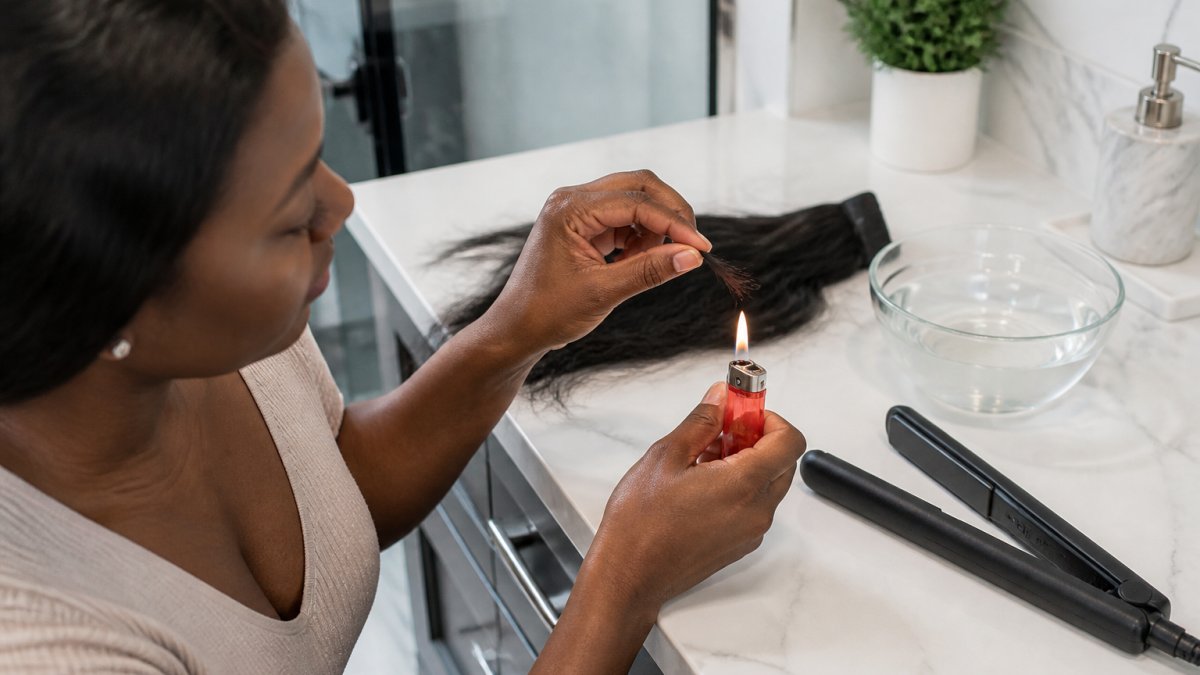
The human hair burn test is the most reliable at-home check, as long as you do it safely. Burn a small strand and watch the smell and the residue.
If the strand melts into a plastic ball, you're holding synthetic fibre or a blend. If it turns to ash and smells like burnt hair, it's likely real.
The heat test is quick, but use a low setting and a hidden strand. Clamp a straightener on low heat over a small section for a few seconds.
Real hair takes the heat and holds a shape. Synthetic fibre may stick to the plates, frizz, or develop a shiny, melted patch, a clear sign of synthetic content.
The water test is the least destructive of the bunch. Drop a single strand into a bowl of water and watch.
Human hair absorbs water over time and tends to sink. Synthetic fibre usually floats because it repels water. It's not foolproof with treated or coated hair, but it's a useful early clue.
If you want to know how to tell if hair extensions are real without burning or cutting anything, start with your eyes and hands. These checks won't damage the product, so you can run them in-store or as soon as a delivery arrives.
The burn test is the check most guides lead with, and the one most likely to go wrong. A flame near a product you have just paid for, in a room with soft furnishings and no ventilation, is a genuine hazard. The safe version is short, small and controlled.
Signature Glamour Package human hair bundles 16" 18" 20"+16" 5X5 hdlace →
Hold the strand with metal tweezers over the heat-safe surface. Bring the flame to the tip for no more than a second or two, then move the flame away and watch what happens. You are looking for two things: the smell and the residue.
The burn test is useful, but not definitive. Heat-resistant synthetic fibres can be engineered to behave like real hair under a brief flame, and coated real hair can leave a misleading residue.
If you are testing in a rental, a share house or any space where a flame is not appropriate, skip the burn test entirely. The water, texture and inspection checks in this guide are designed for exactly that situation.
Blends are the hardest thing to catch, and labels are the reason. A bundle can contain real hair mixed with synthetic fibre, and that mix can pass several tests at once.
The label makes it worse.
If you cannot wet, heat or burn the product, you can still gather useful evidence before money changes hands.
If you have bought hair that was described as human hair and your checks suggest otherwise, keep the listing, the invoice, the packaging and photographs of the product and any test results. Raise it with the seller in writing first. If that does not resolve it, the consumer affairs body in your state or territory can help. The record you kept is what makes the complaint actionable.
No single test is conclusive. That's the part most guides skip.
| Test | What It Shows | Where It Falls Short |
|---|---|---|
| Burn test | Ash vs melted bead, smell | Blends can pass on the real-hair portion |
| Heat test | Reaction to styling tools | Treated synthetic can resist low heat |
| Water test | Absorption vs repulsion | Coated real hair can float |
| Texture test | Feel and uniformity | Processed real hair can feel unusually smooth |
| Smell test | Plastic vs burnt-hair odour | Faint blends mask the plastic smell |
When tests give mixed results, or the stakes are high, get a professional opinion. A stylist who works with hair daily can often tell real from synthetic by feel and behaviour alone.
Ready to move from testing to buying? Our guide to choosing hair extensions walks you through matching hair type, length and budget to your needs.
The simplest way to avoid fake hair is to buy from a seller who is clear about what you're getting. At Big Star Hair & Beauty, we stock both human and synthetic options, so you can choose with confidence.
If you're looking for human hair, our Signature Glamour Package human hair bundles pairs 16", 18" and 20" bundles with a 16" 5x5" HD closure for full coverage.

Check whether the listing names a specific origin such as Remy or virgin hair. Look for consistent thickness from root to tip, a natural shine rather than a plastic gleam, and a price that matches genuine human hair. A bundle set like the Signature Glamour Package, which pairs 16, 18 and 20 inch bundles with a 16 inch 5x5 HD closure for $599, gives you a clear specification to compare against. Avoid listings that only say 'human hair' with no detail.
It can help, but treat it as one clue rather than proof. Real human hair singes and smells like burnt hair, leaving soft grey ash that crumbles. Synthetic fibre melts into a hard bead and smells of plastic. The catch is that blends behave somewhere in between, and a small strand test can miss a synthetic weft hidden higher up. Always test a spare strand from an inconspicuous area, keep a bowl of water nearby, and never burn hair while it is attached to your head.
Human hair can be dyed, bleached and heat-styled, and it absorbs water and moisture like your own hair, so it tends to last longer with proper care. Synthetic fibre has a set curl pattern, resists water, and will melt at high heat, so styling tools need to stay on a low setting. Synthetic options cost less and hold their style in humidity, which suits short-term wear. Human hair costs more upfront but gives a more natural appearance and movement over months of use.
Document everything first: photograph the hair in daylight, note the texture, shine and any melting or plastic smell, and keep the original packaging and listing screenshots. Contact the seller in writing within the return window and describe the mismatch clearly, for example that a product sold as human hair melted under low heat. Check the seller's returns policy before ordering so you know your options.
The real challenge isn't learning the tests. It's finding a seller who stands behind what they sell. Big Star Hair & Beauty gives you clear human and synthetic options, expert in-salon installation, and honest guidance on which hair suits your needs. Get started with Big Star Hair & Beauty and choose hair you can trust from the first strand to the last.
"Show off incredible feedback from your customers"
