


Offer
Provide additional details about the offer you're running.
FLASHSALE
This store requires javascript to be enabled for some features to work correctly.


Last Updated: November 1, 2026
Quick Summary
To fix crusty wig hairlines, soak the lace with a dedicated adhesive remover, wait a full minute, then gently lift the residue with a cotton swab instead of pulling dry lace. Match your cleaning method to the cause, since dried glue, styling product, makeup and damaged lace each need different treatment.
A crusty hairline is dried adhesive, oil and dead skin cells trapped in the lace, not damage to the hair itself. The fix starts with knowing which of four causes you're dealing with. Below, we'll show you exactly how to fix crusty wig hairlines, from the first soak to the final soft finish.
The good news: most crusty hairlines are reversible. The lace itself is usually fine. What has stiffened is the layer sitting on top of it.
Not every scratchy lace has the same origin. Treat the wrong cause and you'll waste time, or worse, tear the lace.
If you're still deciding how to install your next wig, our guide to natural looking wig installation tips walks through the steps that keep a hairline clean from day one.
Soak first, peel second, and never pull dry lace. A dedicated adhesive remover does the work; your hands just guide it. This is the step most people rush, and it's where lace gets torn.
Here's the safe removal sequence:
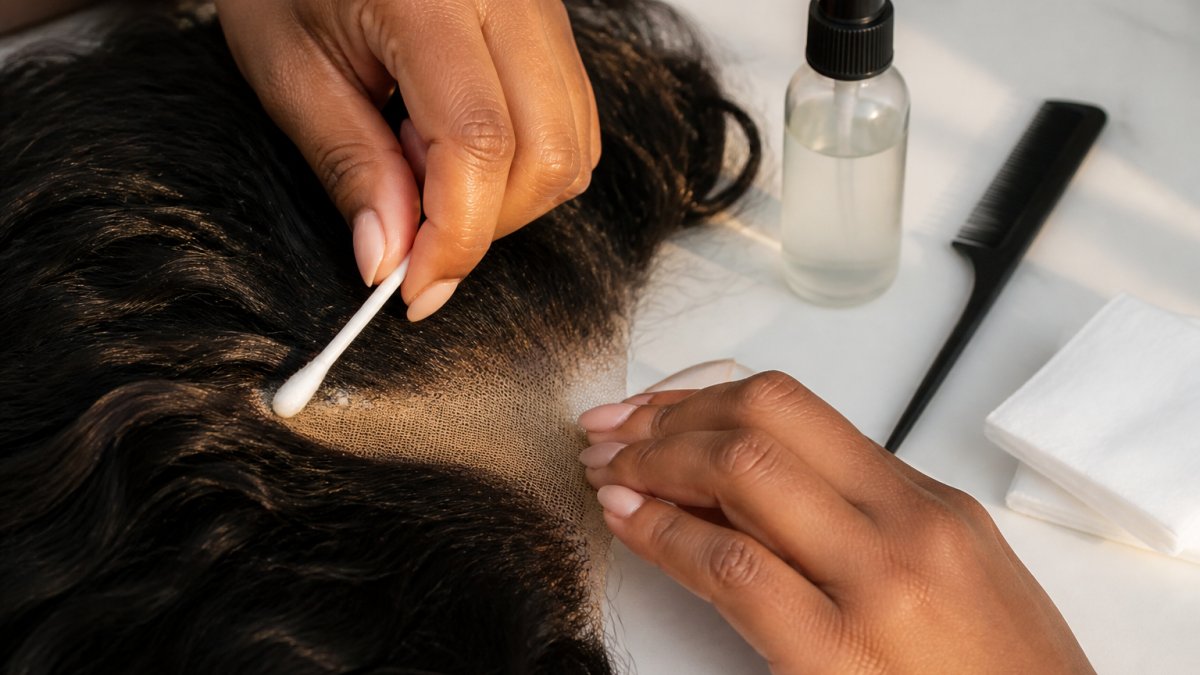
A purpose-made solvent makes this far easier than household alternatives. Our BigStar Easy Glue Remover 30 ml is designed for wig tape and glue residue and can be used on both synthetic fibre and human hair wigs.

Watch out: picking at dry adhesive is the single fastest way to rip a lace front. If a patch won't budge, add more remover and wait.
Spot-cleaning only works if you match the method to the substance causing the stiffness. A crusty hairline can be dried adhesive, styling-product buildup, makeup transfer, or damaged lace, and each needs a different approach. Treating the wrong cause wastes time and can weaken the lace.
Use this diagnostic table before you start:
| What you see or feel | Likely cause | First step |
|---|---|---|
| Hard, shiny, slightly tacky film | Dried adhesive | Adhesive remover, then spot-clean |
| Stiff, matte, flaky residue | Styling product (edge control, serum, mousse) | Lukewarm water and gentle soap |
| Oily, tinted smudge | Makeup or foundation transfer | Micellar water on a cotton pad |
| Rough, frayed, or thinning lace | Damaged lace | Do not scrub, move to repair |
Once you know the cause, spot-clean the hairline only.
Work in small sections:
For adhesive residue, apply remover with a cotton swab and wait a full minute before lifting, never pick at dry glue. For product buildup, a drop of gentle sulphate-free soap on a damp cloth is enough; work from the outer edge inward and rinse the cloth after each pass. For makeup, a micellar-soaked pad pressed and held for a few seconds lifts pigment without scrubbing the knots.
The US National Library of Medicine resource on skin and scalp care notes that skin under adhesives benefits from being kept clean and dry between applications, which applies equally to the scalp beneath a lace front.
Let the lace dry flat and face-up. Trapping moisture under a wig cap is how mildew and lingering odour start. If the lace still feels stiff after spot-cleaning, the cause is likely damaged lace rather than residue, move to the repair section rather than repeating the clean.
Big Star Strong Hold Lace Wig Glue 38ml →
Softening comes first, then patching, then trimming. If the lace feels crunchy but is intact, a light mousse worked in with fingertips and left to dry can restore flexibility. If the lace is torn, patching is the fix, but the method depends on the lace material.
| Lace type | Handling | Patch method | When repair is unlikely to hold |
|---|---|---|---|
| HD lace | Very delicate; minimal handling | Ultra-thin patch, light adhesive, no heat | Tear longer than 1 cm or frayed edges |
| Transparent lace | Moderate handling | Standard patch, thin adhesive line | Multiple small tears in one area |
| Regular lace | More robust | Standard patch, can tolerate slightly more adhesive | Tear across a knot row or at the hairline edge |
HD lace is the least forgiving: the fibres are finer, so a patch that works on regular lace can show as a visible ridge. Use the thinnest spare lace you have and apply adhesive sparingly. Transparent lace sits between the two, it can take a standard patch but still shows bulk if you overlap too much. Regular lace is the most tolerant, but a tear that crosses a knot row will continue to shed hair even after patching, so repair is usually temporary.
For a tear, follow these steps:
| Situation | Recommendation |
|---|---|
| Small tear under a few centimetres, single area | Patch it |
| Crunchy but intact lace | Soften with mousse |
| Tear across a knot row or at the hairline edge | Professional repair or replace |
| Multiple tears along the hairline | Replace the unit |
| Lace lifting at the edges only | Re-glue with strong-hold adhesive |
| HD lace with a tear longer than 1 cm | Replace, repair rarely holds invisibly |
If you are unsure, a simple test helps: gently flex the lace between your fingers. If it crackles or feels brittle rather than supple, the fibres are breaking down and a patch will only delay the inevitable. In that case, professional repair or replacement is the better spend.
Material matters here. Delicate Swiss-style lace needs a lighter touch than thicker French lace, and synthetic units should never be treated with high heat near a repair.
Dryness at the hairline usually means the hair has lost moisture, not that the wig is finished. A gentle cleanse, a light conditioning treatment and cool-air drying bring most human hair units back.
Try this routine:
For deeper frizz control, our guide on how to prevent hair extensions from frizzing covers the habits that keep hair soft long-term.
Prevention beats repair every time. A five-minute routine each week keeps lace soft and stops buildup before it hardens.
The glue you choose matters too. Our Big Star Strong Hold Lace Wig Glue 38ml is designed for lace front and full lace wigs and dries clear, with a precision applicator tip.

Some hairlines need hands-on help. If your lace is torn, lifting, or just won't sit flat, our in-salon team can help with installation and styling.
We offer expert wig and extension installation, styling and braiding, plus masterclass training if you want to learn the craft yourself. If you'd rather have it done properly, you can find and book a professional install service near you.
Start by identifying the cause: leftover adhesive, product buildup, hard water minerals or dried-out lace. Work in sections, soften any glue with a dedicated remover such as Big Star Easy Glue Remover ($25.00), then lift residue with a cotton swab instead of pulling. Clean the lace with a mild soap and lukewarm water, rinse, and let it dry completely before restyling. If the lace itself has stiffened, a short soak and gentle conditioning usually restores flexibility. Fixing crusty wig hairlines is mostly about removing buildup patiently rather than scrubbing hard.
Isopropyl alcohol can break down some adhesive residue, but it also dries out lace and can weaken knots, so use it sparingly and only on stubborn spots. Apply with a cotton swab rather than pouring it on, keep it away from the hair where possible, and follow with a gentle wash to remove any residue. For regular cleaning, a purpose-made remover designed for wigs and hairpieces is safer because it targets the glue without stripping the lace. Always patch test on a hidden area first.
Soften the glue before you lift it. Apply a wig-safe adhesive remover along the hairline, wait a minute or two, then roll the residue away with a cotton swab or your fingertip. Never pick at dried glue with nails or tweezers, because that is how lace tears. Work in small sections and reapply remover as needed. Once the glue is gone, wash the lace gently and let it dry fully. Big Star Strong Hold Lace Wig Glue ($25.00) is available alongside the Big Star Easy Glue Remover.
Remove and clean your wig after every install rather than layering fresh glue over old residue. Use a thin, even line of adhesive, let it go tacky before pressing the lace down, and avoid touching the hairline with styling products. Wash the lace every few wears with mild soap, dry it flat, and store the wig on a stand or in a breathable bag. Big Star Hair & Beauty offers professional wig and extension installation services.
Crusty hairlines are a maintenance problem, not a dead end. With the right remover, a gentle cleaning routine and quality adhesive, your lace front can look soft and natural again. Big Star Hair & Beauty stocks the glue and remover that make the routine work, and our salon team is here when you'd rather leave it to the experts. Get started with Big Star Hair & Beauty and bring your hairline back to life.
"Show off incredible feedback from your customers"
